
Erosion control
Slope Blankets & Hydromulch in New York, NY
Keeping seed and soil on steep yards, banks, swales and ditches until roots take over.
- No-charge site visit and a written quote before any work
- Quotes split prep, seed mix, mulch and erosion items line by line
- Grass blend picked for the light and soil on your lot
When Gravity and Rain Work Against the Seed
Slope blankets and hydromulch are the erosion control tools we reach for when a seeded area is steep, carries water or cannot afford to wash out. Across the New York suburbs that means hillside backyards in Yonkers and Greenburgh, banks along driveways in Rockland, moraine slopes on the North Shore, and swales and drainage ditches that collect runoff from a whole street. Plain hydroseed holds well on gentle ground; these jobs need more.
Why slopes fail here
Rain arrives in every month in this region, and storms can be intense. Westchester's bedrock of gneiss and mica-schist puts rock near the surface on many hillside lots, so soil is thin and runoff gathers speed. On Long Island the moraines are made of loose glacial material that slumps once it is cut and left bare. Either way, the first hard rain after seeding concentrates water into rills, and once a rill forms it carries seed, mulch and soil downhill with every storm after.
Blankets
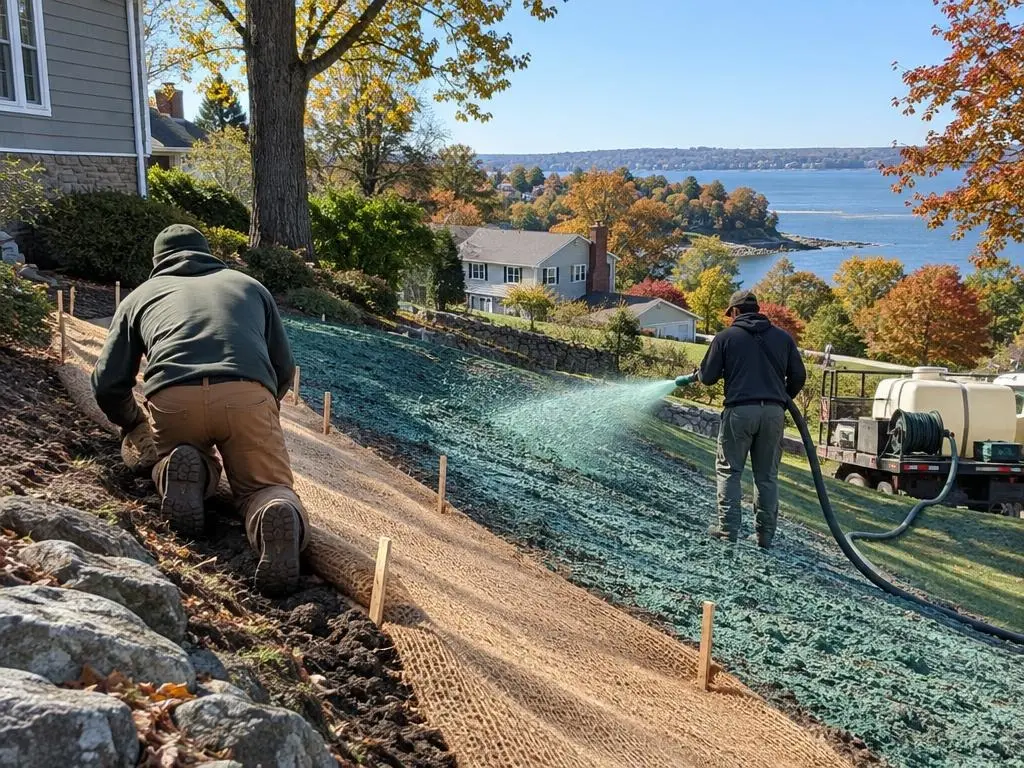
A blanket is a roll of straw, coconut fiber (coir) or a blend of the two, held together with light netting and pinned to the slope with staples. Seed goes down first, then the blanket on top. The blanket shields the soil from raindrop impact, slows sheet flow and holds moisture while the grass grows through it. Straw blankets suit moderate slopes and break down within a season or so; straw-coir and pure coir blankets last longer and suit steeper banks and channel bottoms where water runs. We trench the top edge in, overlap the rolls in the direction water flows and staple to the pattern the manufacturer specifies.
Hydromulch and bonded fiber matrix
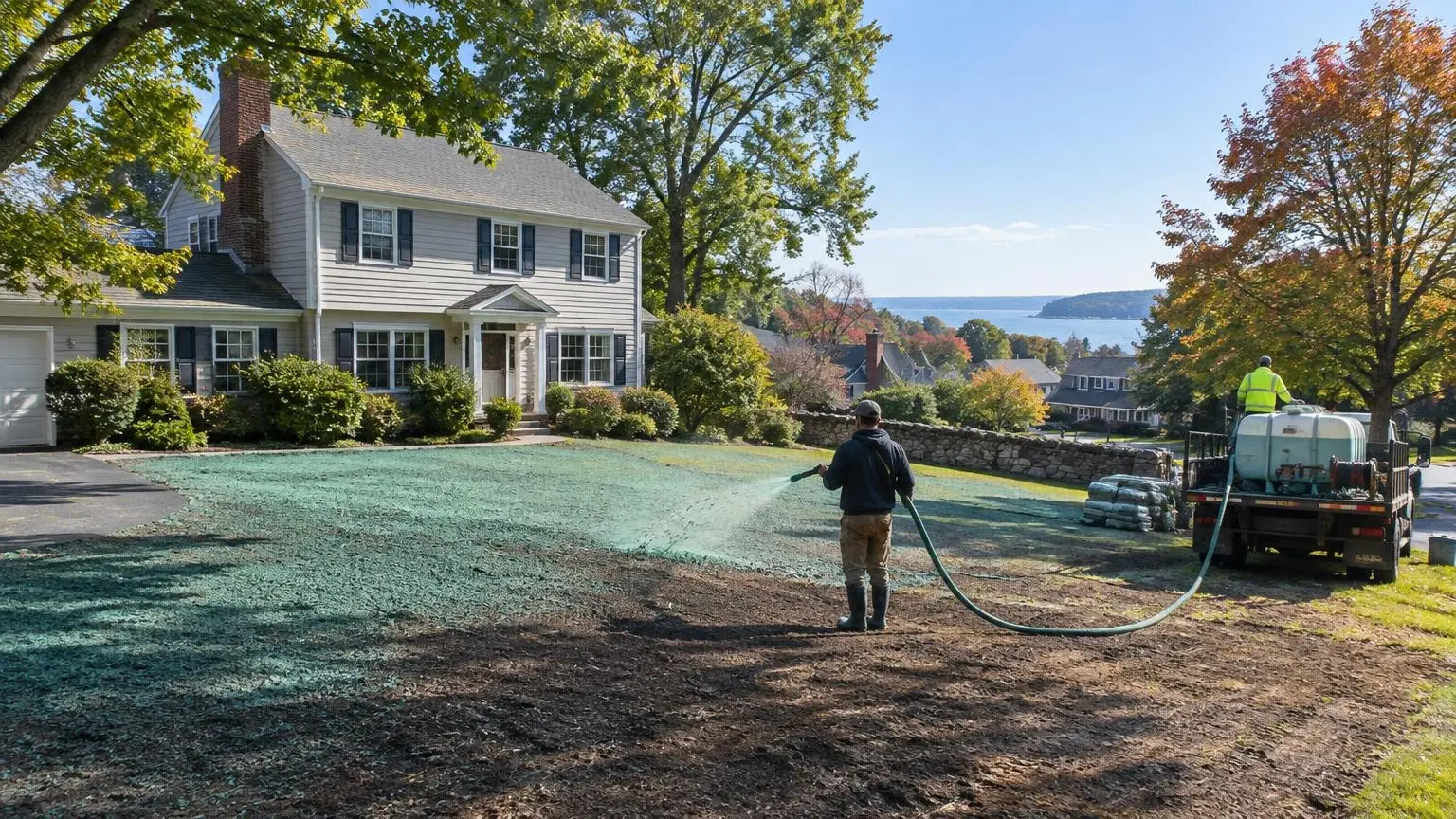
Where blankets are hard to install, such as on large, irregular or rocky slopes, we spray heavier hydromulch. Standard wood or paper fiber mulch at a higher rate gives better cover than lawn rates. A bonded fiber matrix adds binders so the mulch forms a stronger, connected layer that resists runoff better than plain mulch, and it can be sprayed from the top of a slope without anyone walking on the soft face. Penn State Extension points out that mulch is particularly important on sloped areas, where the chance of erosion is higher, and that poor mulching can leave seed and soil moving.
Swales and ditches
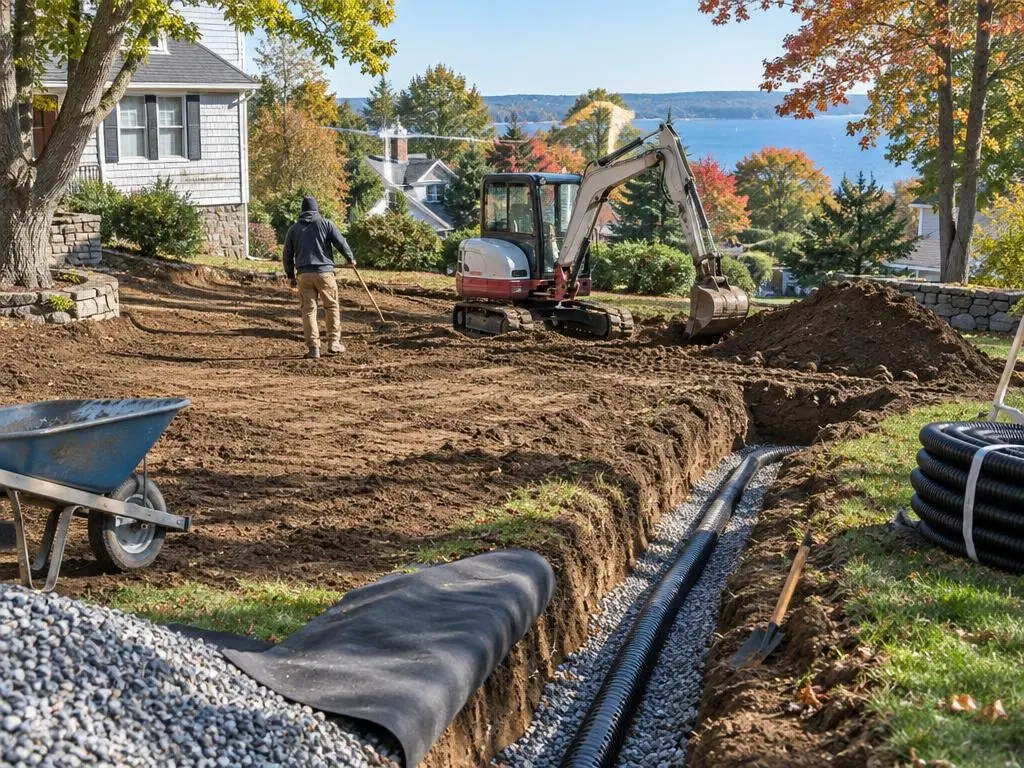
A swale that carries water from a driveway or a neighbor's yard is a channel, not a lawn, at least until the grass is established. We shape the bottom so flow spreads instead of cutting a groove, seed it, and line it with a blanket rated for flowing water. Where water drops off a slope, a short stretch of stone at the outlet keeps the toe from washing out.
Slope stabilization beyond seed
Some slopes are too steep to mow or keep in grass. Penn State suggests considering retaining walls or ground covers where grades change sharply. We will tell you when a slope is a seeding job and when it needs a wall, terracing or a planting plan instead.
Erosion control services for homeowners and builders
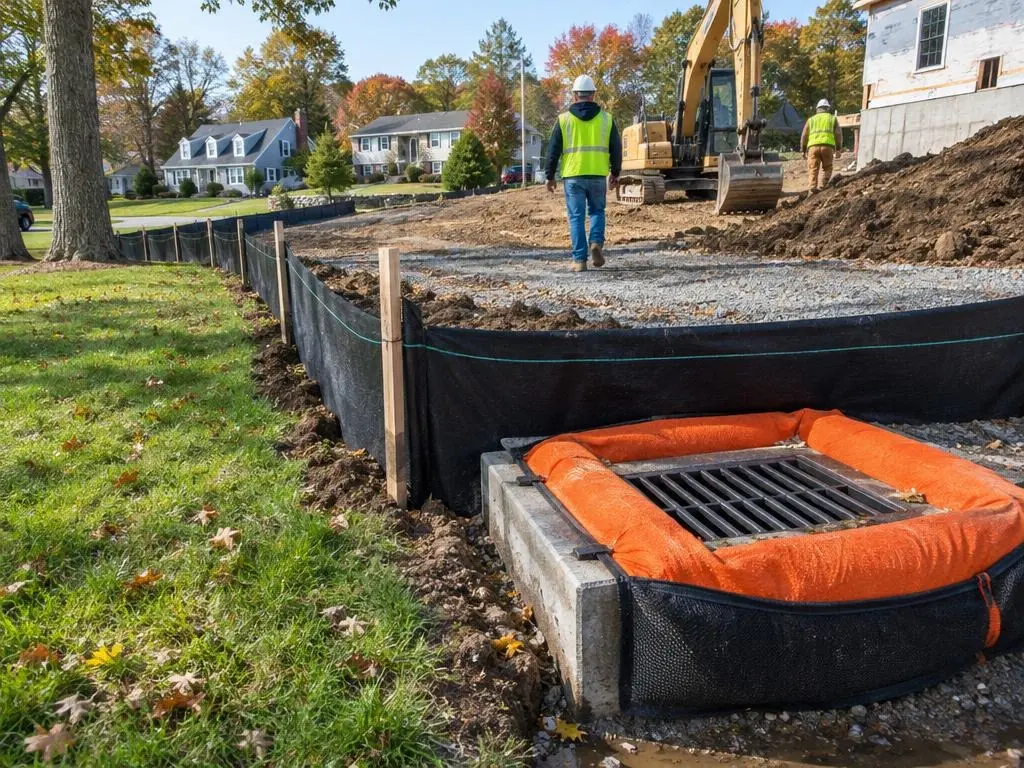
Most of our erosion control jobs fall into two groups. Homeowners call after a regrade, a pool or a retaining wall leaves a bank of bare soil above the patio, or after a storm cuts a gully through the side yard. Builders and erosion control contractors call when a SWPPP requires blankets on specific slopes or when an inspector flags bare banks. The materials are the same; the paperwork is different. On permitted sites we follow the drawings; on residential jobs we pick the product and explain why.
Maintaining a seeded slope
The first season decides whether a slope holds. Water has to reach the top of the bank, not just the bottom, and that usually means a sprinkler placed uphill or a soaker line along the crest. Check the slope after each heavy rain for rills, exposed staples or blanket edges that have lifted, and call us early; a small repair in week two is cheap, and a gully in week eight is not. Mow high or not at all on steep banks for the first year, and keep foot traffic, pets and equipment off until the grass has knitted in. Once the cover is established, a slope seeded with the right mix needs far less care than the yard below it.
Timing on slopes
Slopes are the worst place to seed late. Grass on a bank needs roots before winter freeze and thaw cycles start heaving the surface. We aim to finish slope seeding by early fall where we can. When a slope has to be covered later than that, a blanket or bonded fiber matrix carries much more of the load until spring, and we may add a quick-sprouting nurse grass to the mix so something is holding the soil before the ground cools.
Erosion Control Options
We match the treatment to the slope, the water and the timeline.
Straw erosion control blankets
Single or double net straw mats for moderate slopes; break down as grass fills in.
Straw-coir and coir blankets
Longer-lasting mats for steeper banks and swale bottoms that carry water.
Heavy-rate hydromulch
Wood or paper fiber mulch at higher rates for slopes too rough for blankets.
Bonded fiber matrix
Hydraulically applied mulch with binders for steep, hard-to-reach slopes.
Swale and ditch lining
Shaping, seeding and channel-rated blankets for drainage paths.
Outlet and toe protection
Stone or matting where water leaves a slope or channel.
Erosion Control Rates We Can Point To
| Item | Rate and source |
|---|---|
| Straw/coconut 70/30 blanket, installed, per a 2025 state DOT erosion cost sheet | $468 per 1,000 sq ft |
| Coir blanket, installed, same 2025 sheet | $532 per 1,000 sq ft |
| Hydraulic wood mulch, same 2025 sheet | $98 per 1,000 sq ft |
| Steep slope add-on for hydroseeding (HomeGuide) | $0.05-$0.10 per sq ft extra |
| Bonded fiber matrix | No current published figure; quoted on site |
That cost sheet is a state highway reference, not a New York contractor price list. Slope length, access and the product chosen set the cost. Market ranges; your written proposal from us is the binding figure.
How We Stabilize a Slope
1. Read the slope
Steepness, length, soil depth, where water comes from and where it leaves.
2. Fix the surface
Fill rills, smooth the face and key in any loose fill.
3. Seed
Hydroseed or broadcast the mix suited to the slope and how it will be maintained.
4. Cover
Blankets trenched and stapled, or hydromulch or BFM sprayed at the planned rate.
5. Check after storms
We look at the first heavy rain's results and repair any weak spots.
Why Choose Us for Slope Blankets & Hydromulch
Product matched to water
Channel-rated blankets where water runs, lighter cover where it does not.
Installed to spec
Top trenching, overlaps and staple patterns follow the manufacturer.
Honest about limits
If a slope needs a wall, we say so before you pay for seed.
Slope Blankets & Hydromulch Questions
Blanket or hydromulch: which does my slope need?
Blankets give the most protection on slopes that are steep or carry water, and on swale bottoms. Heavier hydromulch or bonded fiber matrix suits large, rough or rocky slopes where pinning blankets is impractical. We decide after looking at the slope and where runoff comes from.
Do I have to remove the blanket later?
No. Straw and coir rot away on their own, and by then the grass has rooted through the fibers. Netting on some products lasts longer; we can suggest lighter or biodegradable netting near areas pets or wildlife use.
Can grass really hold a steep bank in Westchester?
On moderate slopes, yes, once established with a blanket's help. Very steep cuts over shallow rock may never hold mowable turf well; ground covers, terracing or a wall may serve better, and if your bank falls in that group we will say so before quoting seed.
What is bonded fiber matrix?
It is a hydraulically sprayed mulch with binders that creates a stronger, connected cover than plain mulch. It is used on steep slopes where blankets are hard to install, and it can carry seed in the same application.
Slope Blankets & Hydromulch Service Areas
- Hydroseeding in New York, NY
- Hydroseeding in Staten Island, NY
- Hydroseeding in Hempstead, NY
- Hydroseeding in Levittown, NY
- Hydroseeding in Garden City, NY
- Hydroseeding in Oyster Bay, NY
- Hydroseeding in North Hempstead, NY
- Hydroseeding in Port Washington, NY
- Hydroseeding in Huntington, NY
- Hydroseeding in Smithtown, NY
- Hydroseeding in Islip, NY
- Hydroseeding in Babylon, NY
- Hydroseeding in Yonkers, NY
- Hydroseeding in White Plains, NY
- Hydroseeding in New Rochelle, NY
- Hydroseeding in Scarsdale, NY
- Hydroseeding in Greenburgh, NY
- Hydroseeding in Mount Pleasant, NY
- Hydroseeding in Harrison, NY
- Hydroseeding in Yorktown, NY
- Hydroseeding in Clarkstown, NY
- Hydroseeding in Ramapo, NY
- Hydroseeding in Orangetown, NY
Get a Slope Blankets & Hydromulch Estimate
Send a photo of the slope from the bottom and from the side.