
Island and suburban lawns
Hydroseeding in New York, NY
Seed, mulch and erosion control for the yards and job sites of Staten Island, Long Island, Westchester and Rockland.
- No-charge site visit and a written quote before any work
- Quotes split prep, seed mix, mulch and erosion items line by line
- Grass blend picked for the light and soil on your lot
Grass for the Parts of New York That Have Yards
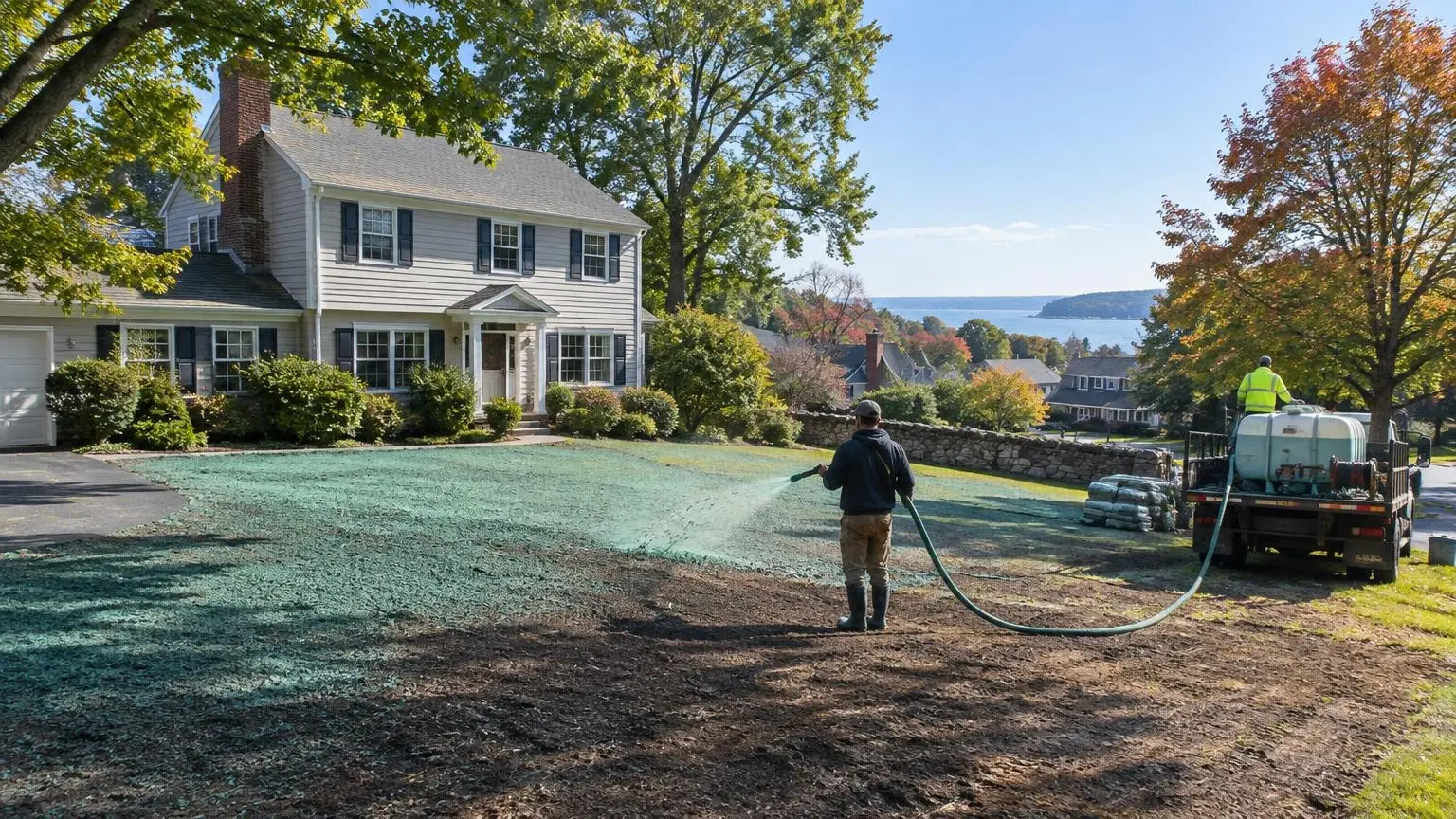
Hydroseeding is how we put down new lawns and cover bare ground across the New York metro, mostly in the places where people actually have yards: Staten Island, Nassau and Suffolk on Long Island, Westchester, and Rockland across the Hudson. Grass seed, a wood or paper fiber mulch, fertilizer and a tackifier get blended with water in a tank and sprayed over a prepared seedbed. That fiber layer keeps the seed damp and pinned to the soil so wind and rain cannot carry it off, which is a large part of why it works on slopes and wide-open lots where dry seed and straw would not stay put.
Where the method came from
Hydroseeding started in the 1940s with a Connecticut highway engineer who found that a slurry of seed and water could be sprayed onto expressway slopes nobody could reach with a spreader. That is still the job it does best: covering big or awkward ground quickly and evenly. Penn State Extension notes that a hydroseeder with a gun can throw the mix more than 100 feet, so a crew can seed a slope from the top without walking on the soft soil. For a homeowner, the same machine covers a regraded backyard in an afternoon and leaves an even green layer you can see, so missed spots are obvious.
What the ground is like here
Most of Long Island was built by glaciers. Moraines run along the North Shore and down the middle, and south of them a broad outwash plain slopes to the bays. The USDA describes the Haven series, a common soil on those outwash plains, as well-drained loam 18 to 36 inches deep over stratified sand and gravel, very strongly to moderately acid. That kind of ground drains fast and dries out on top, so a seed layer needs mulch that holds water, and soil pH matters more than people expect. Westchester is different: the county sits on gneiss and mica-schist, with steeper lots, rock near the surface and runoff that moves quickly. Staten Island has hills of its own, and Rockland rises from the Hudson into real slopes. One seed plan does not fit all four.
Weather and seeding windows
New York City itself sits right at the northern edge of a humid subtropical climate, while Long Island and Westchester straddle the line between that and a humid continental climate. Rain falls in every month: Central Park averages roughly 42 to 49 inches a year, and the Islip airport normals add up to about 46 inches. Our lawns are cool-season grasses, tall fescue, Kentucky bluegrass, perennial ryegrass and fine fescues, and they establish fastest in late summer and early fall. Penn State Extension, writing for the state next door, puts the ideal window in late August and early September, when soil is warm and seedlings get two cool growing seasons before their first summer. Mid to late spring is the second choice. Central Park's average high is still about 76 degrees in September but drops to 64 in October, so the later in fall we go, the slower germination gets.
Sod, hydroseed or dry seed
Sod is the quickest way to a finished lawn but usually the most expensive, and it has to go down within a day or two of delivery in warm weather. Dry seed with straw is the cheapest, but it sits on the surface, washes into low spots and takes longer to show. Hydroseed lands in the middle on price. HomeGuide puts it somewhere between $0.12 and $0.35 a square foot against $1 to $4 for installed sod, and the University of Nebraska Extension says hydroseeded grass usually shows up in 5 to 7 days, where dry seeding tends to need two to three weeks. You give up instant turf in exchange for a lawn grown from a mix chosen for your lot. Get a free estimate
Stormwater rules that shape the work
Bare soil is a sediment problem the moment it rains. Federal construction stormwater rules apply to any project disturbing an acre or more, or a smaller lot that is part of a larger plan, and every one of those permits must require disturbed areas to be stabilized immediately once work stops for more than 14 days. Inside the city, the Department of Environmental Protection requires its own stormwater permit for projects that drain to a city sewer and disturb 20,000 square feet or more, or add 5,000 square feet of new hard surface. Hydroseed, hydromulch, blankets and silt fence are the everyday tools for meeting those requirements, and we install all of them.
What we handle
Most jobs combine several pieces: fine grading and topsoil, the seeding itself, erosion control on any slope or swale, and silt fence or inlet protection on a construction site. Builders and site contractors call us for stabilization and sediment control; homeowners call us after a renovation, a septic or drainage job, or a lawn that never filled in. When the trouble is water pooling against a foundation, our grading crew can dig the trench and set the drain before the yard is shaped and seeded.
Shade, salt and old lawns
A lot of yards across Nassau, Suffolk and lower Westchester were laid out on farmland in the postwar decades, and the oaks and maples planted then now shade lawns that were seeded for full sun. Near the bays and the Sound, wind and salt spray dry out the surface faster than inland. Both change the mix we spray: more fine fescue where the canopy is heavy, tougher tall fescue where wind and sun hit hardest. It is also why we look at a yard in person before recommending anything; the same street can have a sunny front lawn and a backyard that sees three hours of light.
What a quote from us looks like
You get a written quote listing each piece of the job: grading or topsoil, the seed mix by name, the mulch type and rate, any blankets, silt fence or inlet protection, and haul-off if there is any. If something about the site could change the price, such as rock under the topsoil or a slope steeper than it looks, we say so in writing before you sign. Nothing gets added once we are on site without your approval.
After we spray
The green color fades in a few days as the mulch dries. Keep the surface damp, not soaked, for the first few weeks; Penn State notes that new seedlings have shallow roots and often need daily irrigation, less in cool or rainy stretches. Stay off it until it is established, and mow for the first time when the grass is about a third taller than the height you plan to keep it. We leave written instructions for your lot on the day we seed.
Common Questions
What is hydroseeding?
It is seeding with a sprayed slurry: grass seed, fiber mulch, fertilizer and a tackifier mixed with water in a tank and pumped onto prepared soil. The fiber keeps the seed from drying out, and the tackifier glues the whole layer down. It is faster than hand seeding on large areas and holds on slopes where loose seed would wash off.
Will heavy rain wash away hydroseed?
A soft rain after spraying is welcome. A downpour on a slope or in a swale can move seed and mulch, especially in the first few days before the mulch sets. On steep or channelized ground we use heavier hydromulch or an erosion control blanket and try to schedule around forecast storms.
Which month should I hydroseed a lawn around New York?
Late August through September is the target for the cool-season grasses we use here. The soil is warm, weeds slow down, and the seedlings get fall and spring to root before summer heat. Mid to late spring works as a second choice; midsummer and late October seedings are more of a gamble.
What grasses do you seed on Long Island and in Westchester?
Cool-season grasses: turf-type tall fescue, Kentucky bluegrass, perennial ryegrass and fine fescues. Sunny, well-drained lots usually get tall fescue or a bluegrass and ryegrass blend; shady yards under oaks and maples lean on fine fescues. We set the mix after seeing the light and soil.
Do you work in Manhattan?
Our work is mostly where there is open ground: Staten Island, Long Island, Westchester and Rockland. We do take city jobs with real soil to seed, such as a large rear yard, a slope or a construction site that needs stabilizing. Call and describe the space.
How soon can we use the new lawn?
Grass usually shows within one to two weeks. Keep foot traffic off until it is established, and plan the first mow when the grass is roughly 4 inches tall if you will keep it at 3. Most yards are ready for light use after a couple of mowings.
Is hydroseeding cheaper than sod here?
Usually by a wide margin. National cost guides put hydroseed between $0.12 and $0.35 a square foot and installed sod at $1 to $4. Sod gives you a finished look the same day; a hydroseeded yard needs a few weeks to thicken up, but you get to choose the seed mix.
Our Services
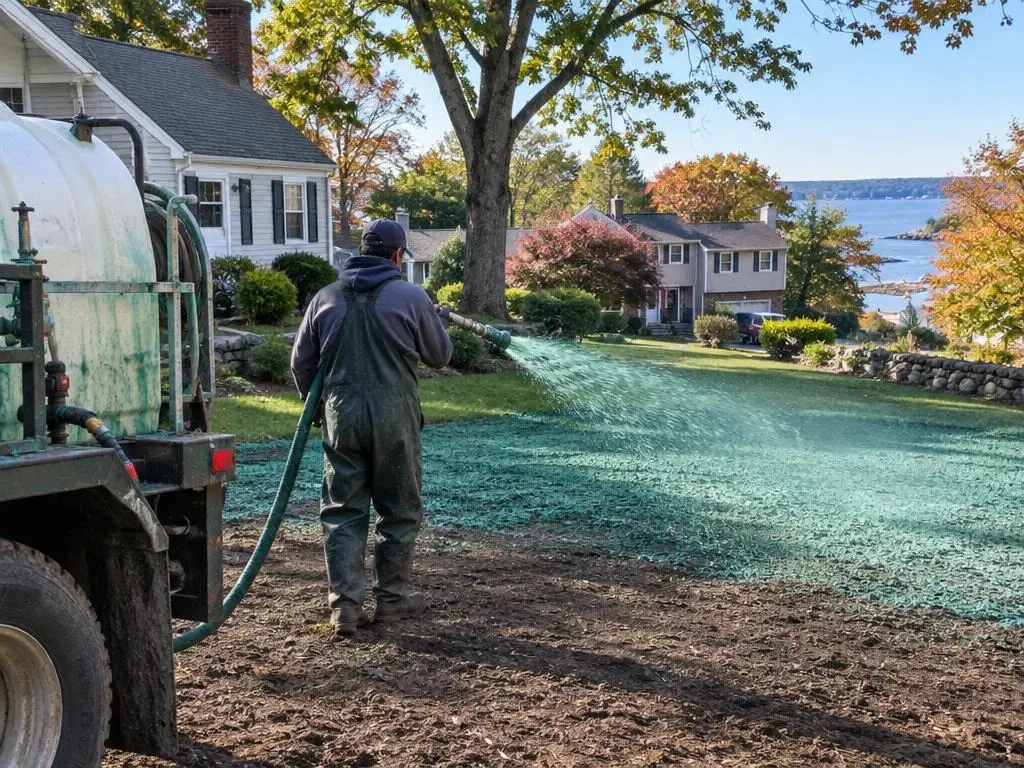
Six lines of work, sized for anything from one Staten Island backyard to a Suffolk job site that has to be stabilized before the inspector comes.
Residential Hydroseeding
New lawns sprayed onto prepared yards after a build, a regrade or a dead lawn tear-out.
Learn more →Site Stabilization Hydroseeding
Seeding and hydromulch for builders, developers and commercial sites that must be stabilized.
Learn more →Slope Blankets & Hydromulch
Erosion control blankets, heavy hydromulch and slope seeding for banks, swales and ditches.
Learn more →Silt Fence & Inlet Barriers
Perimeter silt fence, storm drain inlet barriers and other sediment control on active New York building sites.
Learn more →Grading, Topsoil & Drainage Prep
Yard grading, topsoil, dirt work and drainage trenching before seed goes down.
Learn more →Overseeding & Thin Lawn Repair
Aeration, overseeding and patch repair to thicken tired lawns without starting over.
Learn more →From the South Shore to the Ramapo Hills
Our seeding work centers on the lawn-and-suburb side of the metro rather than Manhattan. On Staten Island that means hillside lots around the island's central ridge and newer streets on the South Shore. In Nassau County we work in Hempstead, Levittown, Garden City, Oyster Bay, North Hempstead and Port Washington, where postwar lots on old farmland sit on flat outwash and North Shore homes climb the moraine. In Suffolk we cover Huntington, Smithtown, Islip and Babylon, from harbor hills to low bayfront lots. In Westchester we seed in Yonkers, White Plains, New Rochelle, Scarsdale, Greenburgh, Mount Pleasant, Harrison and Yorktown, much of it in the Bronx River, Croton and Kensico watersheds. Across the Hudson in Rockland we work in Clarkstown, Ramapo and Orangetown, where slopes climb toward the river hills and the Ramapo Mountains. Flat sandy ground needs mulch that holds water; steep, rocky lots need blankets and careful grading first. We plan each job for the ground it sits on.
- Hydroseeding in New York, NY
- Hydroseeding in Staten Island, NY
- Hydroseeding in Hempstead, NY
- Hydroseeding in Levittown, NY
- Hydroseeding in Garden City, NY
- Hydroseeding in Oyster Bay, NY
- Hydroseeding in North Hempstead, NY
- Hydroseeding in Port Washington, NY
- Hydroseeding in Huntington, NY
- Hydroseeding in Smithtown, NY
- Hydroseeding in Islip, NY
- Hydroseeding in Babylon, NY
- Hydroseeding in Yonkers, NY
- Hydroseeding in White Plains, NY
- Hydroseeding in New Rochelle, NY
- Hydroseeding in Scarsdale, NY
- Hydroseeding in Greenburgh, NY
- Hydroseeding in Mount Pleasant, NY
- Hydroseeding in Harrison, NY
- Hydroseeding in Yorktown, NY
- Hydroseeding in Clarkstown, NY
- Hydroseeding in Ramapo, NY
- Hydroseeding in Orangetown, NY
Why Homeowners Call Elite Hydroseeding New York
Seed timed to the calendar
We push for late-summer and early-fall seeding and tell you honestly when a spring or summer date carries more risk.
Soil tested, not guessed
Outwash soils here run acidic. We check pH and nutrients so lime and fertilizer go in the mix where they are needed.
Erosion planned up front
Slopes, swales and job sites get blankets, hydromulch or silt fence in the plan before the first spray.
Line-item quotes
Grading, topsoil, seed, mulch and erosion items are priced separately, which makes it easy to compare bids or drop a piece.
Tell Us About the Bare Ground
We will walk it, test the soil and give you a written quote.